






What Access Panels Are Used in Hospital Expansion Projects across Canada? Posted by Best Access Doors Canada on 3rd Jun 2026
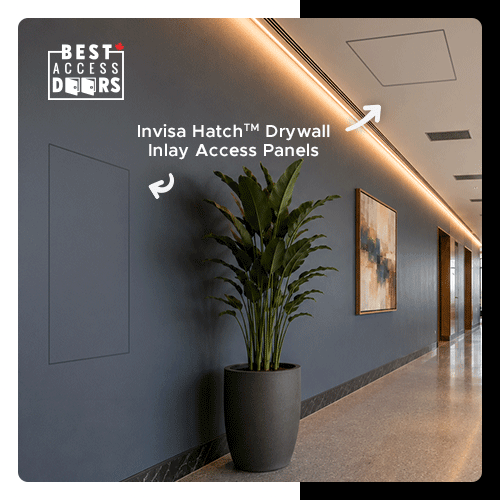
Hospital expansion projects across Canada primarily use concealed drywall access panels that integrate flush with surrounding wall and ceiling assemblies. The panels also support IPC-compatible materials and allow maintenance access without disrupting occupied clinical environments.
The right model for any given space will depend on the assembly type, zone classification, and finish standard for that area of the facility.
That decision carries more weight than it might seem. Specifying the wrong panel can conflict with the surrounding assembly, introduce IPC compliance concerns in occupied patient areas, or trigger a mid-project substitution on a schedule that has no room for it. Getting it right the first time will protect your timeline and keep the project on track.
In this article, we'll cover how hospital renovations shape access panel requirements and what contractors need to consider when specifying panels for hospitals. We'll also look at why the BAC-GRG-RC is the right choice for non-rated wall and ceiling applications in healthcare settings.
How Do Hospital Renovations Influence Access Panel Selection?
Hospital renovations influence access door selection since they prioritize clean finishes, efficient installation, and minimal disruption to ongoing operations.
Unlike standard commercial projects, healthcare renovations often happen in occupied environments. Mechanical, electrical, and plumbing systems frequently need upgrades while adjacent spaces remain in active use. As a result, multiple trades have to coordinate without disrupting ongoing operations or compromising the architectural finishes on patient-facing areas.
Many healthcare construction projects also involve strict scheduling requirements. A delayed material substitution or failed inspection can affect multiple downstream trades. Choosing concealed access panels that already align with project expectations helps reduce that risk.
If you're exploring access panels for healthcare and institutional construction projects, you can browse our full list of drywall access panel options to find models built for hospital-grade environments.
How Do Access Panels Address Infection Control Requirements in Hospital Construction
Access panels address infection control requirements through three core properties:
- Mold-resistant materials that prevent microbial growth
- Flush surface integration that minimizes cleanable seams, and
- Low-disturbance access that limit airborne particles in occupied zones.
Each of these directly affects IPC compliance, and each needs to be confirmed at the specification stage, not resolved during construction.
In Canada, IPC compliance during construction and renovation is governed by the CSA Z317.13 standard and supported by frameworks from Public Health Ontario, Alberta Health Services, and equivalent provincial bodies. These standards require contractors to treat materials, wall assembly finishes, and surface design as integral parts of the infection prevention and control plan, not afterthoughts.
What this means for access panel selection is that:
- Mold and moisture resistance is non-negotiable: Construction materials in healthcare settings must prevent mold or fungal growth, especially in areas adjacent to plumbing, HVAC, or mechanical systems that access panels typically service.
- Surface cleanability matters: Panel surfaces in patient care areas need to accept finishes compatible with healthcare-grade disinfectants without degrading over time.
- Minimal dust generation during access is a priority in occupied zones: Panels that require tools, involve hinge mechanisms that generate friction, or disturb the surrounding assembly each time they're opened introduce avoidable contamination risk.
- Seamless wall integration reduces interruptions to cleanable surfaces: Panels with minimal visible joints, edges, or material transitions are easier to clean and less likely to trap debris along seams.
Specifying panels, like the BAC-GRG-RC, that natively support these infection control considerations reduces your exposure to remediation, mid-project substitution, or compliance review delays.
What Should Contractors Consider When Specifying Access Panels for Hospitals?
Contractors specifying access panels for hospitals in Canada should evaluate five things: IPC compliance, assembly compatibility, finish requirements, installation coordination, and long-term durability.
Hospital projects leave little room for specification mistakes. If an access panel doesn't align with the surrounding assembly or project expectations, you may face inspection issues, delays, or costly substitutions later.
Therefore, before selecting access panels for hospitals, make sure to confirm:
IPC Compliance
Specify panels made from materials that resist mold and fungal growth, particularly in zones adjacent to plumbing, HVAC, or mechanical systems. If the project involves occupied zones or phased construction, confirm that your panel selection aligns with the IPC risk assessment completed at the planning stage.
Getting this right during specification prevents compliance issues at inspection and removes one more variable from an already tight construction schedule.
Wall or Ceiling Assembly Compatibility
Hospital wall and ceiling assemblies vary significantly by location. A corridor in an administrative wing can have different specs than a ceiling plenum in an ICU or a partition in a sterile service area.
As a result, always confirm whether the assembly is rated or non-rated to ensure compatibility with surrounding drywall systems.
Finish Expectations
Many commercial healthcare interiors require seamless wall integration, particularly in public-facing or patient-facing areas.
Concealed access panels help maintain architectural finish continuity because they blend into surrounding gypsum drywall rather than creating highly visible interruptions in the assembly.
Installation Coordination
Hospital renovation projects often involve tight schedules and phased construction sequencing. Lightweight drywall access panels for hospitals can reduce handling difficulty during installation and simplify coordination between trades.
This becomes especially important in retrofit applications where crews may have limited working space or restricted installation windows.
Long-Term Durability
Healthcare infrastructure projects are expected to perform over long operational lifecycles. As a result, evaluate whether the access panels are built with solid materials that resist sagging, corrosion, shrinking, cracking, and moisture-related deterioration.
Working on a hospital project with a high access panel count? Join our Pro Club to get priority quote turnaround, preferred shipping rates, reduced restocking fees, and a dedicated Account Executive so you're never stuck mid-project.
Why Is the BAC-GRG-RC Recommended for Non-Rated Wall and Ceiling Applications in Healthcare?
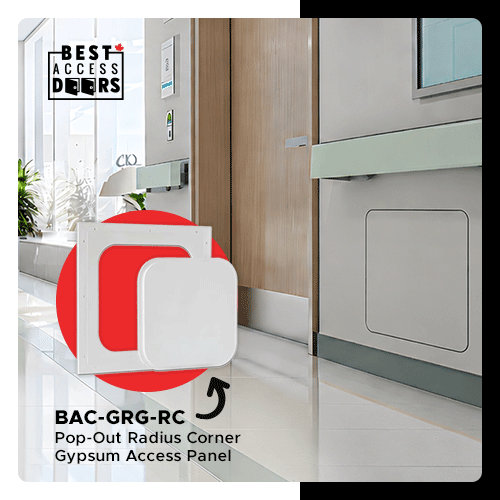
The BAC-GRG-RC Pop-Out Round Gypsum Access Panel is recommended for non-rated healthcare wall and ceiling applications because it combines lightweight installation, seamless drywall integration, and durable performance suited for commercial healthcare interiors.
Hospital projects often require concealed access panels that preserve clean finishes without complicating installation. The BAC-GRG-RC addresses that need with a gypsum-based design that integrates directly into surrounding drywall assemblies.
Let's look at its key features in detail.
Durable Performance for Institutional Construction
Healthcare facilities require IPC-compliant and durable building products that can withstand long-term use.
With that in mind, the BAC-GRG-RC's glass fiber reinforced gypsum construction resists:
- Mold and fungus growth
- Corrosion
- Shrinking
- Sagging
- Cracking
The BAC-GRG-RC is also made from 70% post-consumer recycled glass, which supports sustainability goals.
Hinge-Free Pop-Out Design
The hinge-free design minimizes dust and allows for easy cleaning down the line. It's also useful in spaces where traditional out-swinging access doors may create clearance challenges. There's no hinge to bind, snag, or require service adjustment. As a result, access is straightforward, and the panel can be reinstalled without special tools.
Seamless Wall Integration
Deep tapered edges and radius-edged corners allow the BAC-GRG-RC to be taped, textured, and painted exactly like the surrounding drywall. The result is a concealed access panel that maintains architectural continuity without additional or specialty finishing materials.
Labour-Friendly Installation
The BAC-GRG-RC is designed for easy installation in both walls and ceilings. Its lightweight design reduces installation strain while improving handling efficiency for contractors working across multiple access locations.
The panel also supports single-trade installation, which reduces labour costs and simplifies coordination across phased construction environments.
ASTM-Tested Non-Rated Performance
The BAC-GRG-RC meets ASTM E1264-08 standards and ASTM E84-80 Class A requirements for non-rated assemblies.
Its ASTM E84-80 testing results include:
- Flame spread: 0
- Smoke index: 0
- Fuel contribution: 0
- Combustion classification: Non-combustible
These performance characteristics help contractors confidently specify the BAC-GRG-RC access panel for appropriate non-rated healthcare wall and ceiling applications.
If you're purchasing healthcare facility access panels for a hospital renovation, phased upgrade, or multi-floor project, you can request a quote for the BAC-GRG-RC access panel. You can also check out our custom sizing options to streamline installation coordination and keep your healthcare construction project on schedule.
FAQs on Healthcare Construction Access Panels
1. Are concealed access panels suitable for healthcare facilities?
Yes. Concealed access panels are suitable for healthcare facilities because they support clean architectural finishes and reduce visible disruption across commercial healthcare interiors.
They're especially useful in corridors, consultation spaces, lobbies, and treatment-adjacent areas where finish consistency is important.
2. Can drywall access panels be used in infection-sensitive areas of a hospital?
Yes, provided the panel material and finish are compatible with the IPC requirements of that specific zone. In non-rated, patient-facing areas, panels made from mold-resistant materials, such as glass fiber-reinforced gypsum, are more appropriate than standard panels.
3. What is the difference between a concealed access panel and a standard access panel in a hospital setting?
A concealed access panel blends completely with the surrounding wall or ceiling once it has been taped, textured, and painted. A standard access panel, on the other hand, typically has a visible door, frame, and hardware.
In patient-facing environments, concealed panels are preferred because they maintain the uninterrupted finish expected in commercial healthcare interiors. They also reduce the number of visible seams or edges that could accumulate particulates or create cleaning challenges.
To Sum It Up
Hospital expansion projects across Canada require access panels that balance accessibility, finish quality, and installation efficiency within active healthcare environments.
As a contractor, you need to specify access panels early since healthcare infrastructure projects often involve phased construction, infection control considerations, and strict finish expectations.
For non-rated wall and ceiling applications, the BAC-GRG-RC access panel offers an ideal solution with lightweight handling, seamless drywall integration, durable performance, and ASTM-tested Class A characteristics. This makes it suitable for institutional construction environments.
Contact our team or call +1-888-327-5471 to discuss access panel specifications for your next healthcare expansion project in Canada.