





Exterior Access Doors for Canadian Weather: What to Look For Posted by Best Access Doors Canada on 3rd Nov 2026
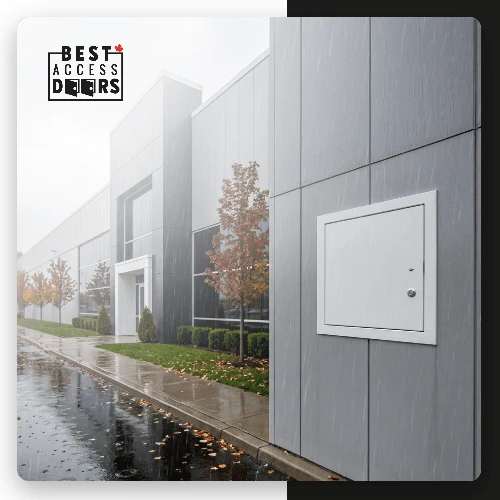
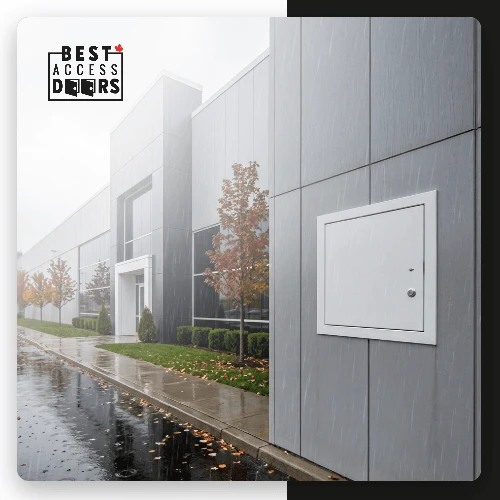
Exterior access doors for Canadian weather need corrosion-resistant materials, continuous weather seals, and insulation matched to the exposure. They also need a proper tie-in to the wall's air and water barrier, or water will find the gap.
In this article, we'll cover how Canadian weather causes door failures, which features to evaluate, how installation matters, and what to check before ordering.
How Does Canadian Weather Cause Standard Access Doors to Fail?
Canadian weather damages outdoor access doors in five predictable ways. Each condition attacks a different part of the door, so identify your site's conditions before you choose exterior access doors in Canada.
Snow Accumulation
Snow piled against a low door traps meltwater at the bottom seal. As the drift melts, that water can sit against the lower frame for hours.
Wind-Driven Rain
Wind-driven rain forces water through gaps that would stay dry in calm weather. Researchers note that Canada often sees substantial wind-driven rain. In their testing, any opening with water on it and a pressure difference across it lets that water through.
Sustained Sub-Zero Temperatures
Long cold spells stiffen gaskets and turn uninsulated panels into cold spots. A hardened gasket stops pressing tightly against the frame, so cold air leaks through. That is why access doors for cold climates need gaskets that stay flexible below freezing.
On the warm side, moist indoor air can also condense on the cold panel and invite mould.
Freeze-Thaw Cycles
Freeze-thaw cycles widen small gaps each time water freezes inside them. Water seeps into a joint, expands as it freezes, and leaves the gap slightly larger after it thaws. Over a season, that cycle breaks down sealant joints.
De-Icing Salt and Coastal Exposure
Salt speeds up corrosion on exposed metal, especially at hinges, fasteners, and cut edges. Environment and Climate Change Canada estimates that about five million tonnes of road salts are used in Canada each year. Doors near driveways and loading docks catch that splash all winter, while coastal sites face salt-laden air year-round.
Planning an exterior opening? Browse our exterior access doors and panels to compare weather-resistant options for Canadian sites.
Which Features Should You Evaluate in an Exterior Access Door?
Weather-resistant access doors depend on five features: material and finish, weather sealing, insulation, door construction, and hardware. Weigh each one against the failure modes at your site.
Material and Finish
Aluminum resists corrosion, though heavy salt can still pit it over time. Stainless steel resists corrosion far better than plain steel, which makes it a strong choice for exterior access panels at coastal sites.
Galvanized and galvannealed steel rely on a zinc coating, so scratches and field-cut edges need touch-up. Primed-only steel belongs on sheltered walls, well away from salt splash.
Weather Sealing
A weatherproof access panel starts with a continuous gasket around the full perimeter. Ask what the gasket is made of and how it holds up in sustained cold. A compression latch also helps by pulling the door tight against that gasket.
For exposed walls, ask whether the door has been tested for water penetration, and to what standard.
Insulation
Choose insulated exterior access doors wherever the door separates heated space from the outdoors. Otherwise, the panel becomes a cold spot that wastes heat and gathers condensation. Compare R-values, since a higher number means better resistance to heat flow. Where both sides are unheated, an insulated access panel matters far less.
Door Construction
Door construction decides how well the panel keeps its shape and seal over time. A double-skin panel with insulation between the layers stays flatter and warmer than a single sheet. On larger doors, look for stiffeners, because a panel that bows can lift off its gasket.
Hardware
Hardware usually corrodes first, since small parts have the least metal to lose. Match the hinge, latch, and fastener material to the door body. Choose a latch crews can work with gloves on, and specify a lockable option where equipment needs protection.
Door Type and Exposure
Match the door type to see how exposed each opening is. A sheltered wall can take a basic gasketed door, while a wall facing prevailing wind needs tighter sealing and insulation. At salt-splash or coastal sites, step up to aluminum or stainless steel with matching hardware.
Related: Access Door Requirements: A Checklist
Where Does the BAC-PPA Fit in Your Product Selection?
The BAC-PPA Flush Aluminum Floor Hatch with Exposed Flange is a good fit where you need aluminum access set flush into a floor opening. Its door, frame, and hinge are all aluminum, so the whole hatch resists corrosion.
- ¼" aluminum diamond plate door: The door is solid ¼-inch aluminum, so damp floors and tracked-in salt won't rust it. Its raised diamond pattern also gives crews a textured surface to walk on while they work.
- Heavy-duty continuous piano hinge: A 0.08-inch aluminum hinge supports the door along its full height instead of at a few points. That spreads the door's weight evenly through repeated openings.
- Recessed handle with cam latch: The handle sits below the door surface and turns a cam latch to hold the hatch shut. With nothing sticking up, the closed hatch stays flush and leaves nothing to trip over in a walkway.
- No-finish aluminum: This product ships as bare aluminum with no paint or coating, so there’s no finish to chip, peel, or touch up after installation or years of foot traffic.
- Locking arm: Doors over 16" x 16" include an arm that holds the door open. Crews can pass tools and parts through the opening with both hands free.
Ready to order? Request a quote or explore custom-size access doors built to your dimensions. Are you ordering for multiple projects? Join Pro Club Canada to get priority treatment and real rewards.
How Does Installation Affect Exterior Access Door Performance?
Installation decides whether a well-built door stays dry, because most leaks start where the frame meets the surrounding assembly. That makes exterior access door installation as important as the door itself.
Wall and Floor Assemblies
The assembly around the opening sets how the frame must be detailed. Concrete, masonry, and framed walls each need different sealing. Floors collect water instead of shedding it, so exposed openings need slope or drainage around the frame.
Barrier Tie-In and Flashing
The frame or flange must connect to the air and water barrier without a break. If the membrane stops short of the frame, water runs behind the door and into the wall. Lap or tape the membrane onto the frame, then add head flashing to direct water out past the cladding.
Perimeter Sealing and Exposure
Seal the perimeter with a joint that can stretch and compress as temperatures swing. A sealant joint over a foam backer rod handles that movement far better than a thin bead. Where you can, also keep openings away from drip lines, snow storage, and salt-splash zones.
What Should You Check Before Ordering Exterior Access Doors in Canada?
Before you order, work through these seven items:
- Exposure: Rate each opening for wind, snow, salt, and heated space behind it.
- Assembly: Note the substrate, membrane, and cladding the frame must tie into.
- Dimensions: Check the rough opening and overall frame size on the spec sheet.
- Materials: Match door, frame, and hardware to the corrosion risk.
- Code requirements: Check the building and energy codes your province enforces, including any fire separation at the opening.
- Documentation: Gather the spec sheets, test reports, and submittals your reviewer will ask for.
- Lead time: Order early, especially for custom sizes, so doors arrive before freeze-up.
Frequently Asked Questions about Exterior Access Doors for Canadian Weather
1. Can an interior access door work on an exterior wall if it's sealed well?
Usually not, because caulking the frame doesn't add what an interior door lacks. Most interior doors have no gasket, insulation, or finish meant for salt. Within a few winters, they tend to rust, leak, or frost over.
2. How often should exterior access door gaskets be inspected?
Check them at least once a year, ideally in the fall before freeze-up. That timing lets crews replace a damaged gasket while it's still easy to work outdoors.
3. Is a weather-resistant access door the same as a watertight one?
No. A weather-resistant door sheds most rain and snow but isn't necessarily sealed against water under pressure. When the difference matters, ask for the test standard and results behind each claim.
Conclusion
The right exterior access door starts with an honest read of each opening's exposure. From there, choose the material, seal, insulation, and construction that answer it.
Installation then decides the result. A door tied into the barrier, flashed, and sealed for movement stands a far better chance of lasting many winters.
Have an exterior opening to spec for this winter? Contact us or call +1-888-327-5471 to talk through sizes, materials, and lead times with our team.