




Top 5 Reasons Access Panels Fail Inspections (And How Contractors Secure Handover) Posted by Best Access Doors Canada on 1st Jul 2026
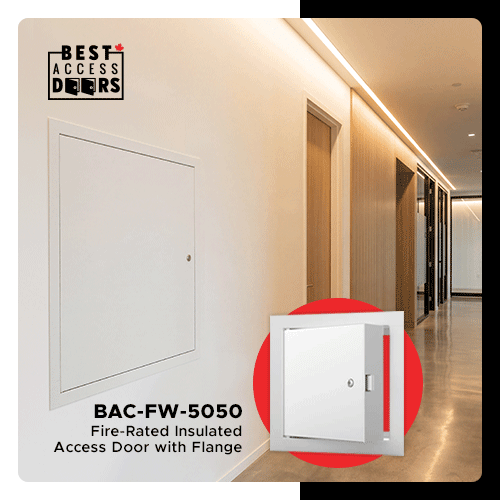
The top reasons access panels fail inspection at closeout include fire rating mismatches, missing ULC labels, incorrect surface applications, operational non-compliance, and installation errors.
Any one of these issues can delay the occupancy permit, which can affect tenant move-in dates, rent commencement, and eventually, your reputation with the building owner.
In this article, we'll cover the reasons that make access panels fail inspections and look at how the BAC-FW-5050 reduces inspection failures.
What Causes Access Panels to Fail Inspections at Project Closeout?
As mentioned, access panel inspection failures are often caused by fire rating mismatches, missing ULC labels, incorrect surface applications, operational non-compliance, and installation mistakes.
These errors can result in costly rework and delays at closeout, especially in commercial office buildings, healthcare facilities, schools, and other institutional projects.
1. Fire Rating Mismatches
A fire rating mismatch means the installed panel doesn't meet the fire resistance requirement of the assembly it's in. For example, a 1-hour fire-rated access door cannot be used in a 2-hour fire-rated wall because it reduces the assembly's overall fire-resistance performance.
A certified fire access door must pass rigorous testing to meet the fire resistance standards set by organizations, such as the Underwriters Laboratories of Canada (ULC). When an installed panel doesn't carry the correct rating for the wall or ceiling assembly it's in, it fails that standard, and no amount of adjustment can fix it.
2. Missing or Non-Compliant ULC Labels
Inspectors normally verify the ULC label on every fire-rated access door. This means a missing, damaged, or voided label can result in a failed inspection regardless of the product's actual fire performance.
Always verify that the fire rating label (e.g., ULC) is visible and legible since labels can become non-compliant in several ways, including:
- Damage during installation.
- Unauthorized field modifications to the door or frame.
- Hardware swaps that substitute non-listed components.
3. Wrong Surface Application — Wall-Rated Panel in a Ceiling Assembly (or Vice Versa)
The National Building Code of Canada sets the minimum standard for building construction. This includes where fire-rated assemblies are required and what they must be rated for (the specific surface type the panel is approved for).
As a result, installing a wall-rated panel in a ceiling assembly (or a ceiling-rated panel in a wall) voids the fire rating even if the panel itself is code-compliant.
4. Operational Compliance Failures
Inspectors also check that every fire-rated access panel self-closes, self-latches, swings freely, and has intact hardware.
NFPA 80 requires that all swinging fire doors be both self-closing and self-latching. As a result, a fire door that doesn’t close and latch on its own provides no fire protection regardless of its rating.
Some of the operational issues that would cause an inspection failure include:
- Propped-open doors.
- Damaged latches.
- Swing paths are obstructed by adjacent trades.
5. Installation-Driven Failures
Installation errors, such as incorrect sizing, misalignment, inadequate clearance, and poor placement, can cause an inspection failure. These failures often trace back to field decisions that were made without reference to the original specification.
Correcting them at closeout means pulling trades back on-site, often after finishes are complete, which is significantly more disruptive and expensive than getting the opening right during rough-in.
The easiest inspection to pass is the one where the right product was specified from the start. Explore our fire-rated products to find ULC-listed access doors built for Canadian commercial and institutional projects.
How Does the BAC-FW-5050 Reduce Inspection Failures at Handover?
The BAC-FW-5050 Fire-rated Insulated Door reduces the risk of inspection failure and helps contractors secure a successful project handover through its:
- Dual-surface fire rating (wall and ceiling).
- ULC listings.
- Built-in operational features.
- Size range that covers standard rough openings across commercial and institutional builds.
Let’s look at its key features in detail.
UL and ULC Fire Rating for Walls
For wall applications, the BAC-FW-5050 carries a UL 1.5-hour "B" label and a ULC 2-hour "B" label, with a maximum temperature rise of 250 degrees after 30 minutes.
It's approved for wall assemblies of up to 36" x 48". This makes it appropriate for fire separations in commercial office buildings, healthcare facilities, schools, and other institutional projects that require wall-rated access.
Warnock Hersey Ceiling Rating
For ceiling applications, the BAC-FW-5050 is approved by Warnock Hersey International for 3 hours in non-combustible ceilings and 1 hour in combustible ceilings, with a maximum size of 24" x 36".
Important note: Fire-rated access doors do not stop fires from starting; they help slow down the spread of a fire for a limited period.
Self-Closing and Self-Latching Hardware
The BAC-FW-5050 comes with self-closing and self-latching hardware built in. The universal self-latching bolt operates by either a knurled knob or a flush key, with master keying available when required.
Steel Construction and Concealed Hinge
The door is built from 20-gauge cold-rolled steel with a 16-gauge mounting frame, filled with 2-inch fire-rated insulation.
The concealed hinge maintains a clean installation profile and eliminates exposed hardware that could be flagged during inspection. The 5-stage iron phosphate preparation with a white baked-on enamel primer coat also provides a durable, finish-ready surface.
Working on a project that needs compliant fire-rated access panels? Request a quote to get pricing fast and lock in the correct spec before your next inspection window. Need a non-standard size? Custom sizing is also available to match your exact rough opening.
What Should You Check Before the Final Inspection at Project Closeout?
Before the final inspection, run through this closeout inspection checklist to catch access panel issues before the inspector does to ensure a successful project handover:
- Fire rating matches the assembly requirement (wall or ceiling) per your project
- ULC label is present, legible, and undamaged on every fire-rated panel.
- Panel is installed on the correct surface type — wall-rated panels in walls and ceiling-rated panels in ceilings.
- The rough opening size is correct, and the panel is properly aligned within the frame.
- The self-closing mechanism fully engages when the door is released.
- Self-latching bolt engages without manual assistance.
- The swing path is clear of obstructions from adjacent trades, equipment, or finishes.
- No field modifications have been made to the door, frame, or hardware.
If you often order access doors across multiple projects, consider joining our Pro Club for priority quote turnaround, expedited order processing, dedicated account support, and preferred shipping rates.
Frequently Asked Questions on Access Panel Inspection Failures
1. Who is responsible when a fire-rated access panel fails inspection?
Responsibility for fire-rated access door compliance typically rests with the general contractor (GC), who is accountable for the project's overall code compliance at handover.
2. What's the difference between a UL and a ULC fire rating on an access door?
UL refers to Underwriters Laboratories, a U.S.-based testing and certification organization. ULC refers to Underwriters Laboratories of Canada, which certifies products to Canadian standards.
3. Can a failed access panel inspection cause certificate of occupancy delays in Canada?
Yes. In Canada, an occupancy permit is required before a building can be legally occupied or used for its intended purpose. The occupancy permit indicates compliance with the applicable building code, and a failed inspection directly blocks that sign-off.
To Sum It Up
Issues such as fire rating mismatches, missing ULC labels, wrong surface applications, operational non-compliance, and installation errors often trace back to wrong decisions made earlier in the project. You can easily prevent them by specifying access doors that meet inspection requirements from the start.
The BAC-FW-5050 is built exactly for that. When you specify this panel, you’ll get a dual-surface fire-rating that covers both wall and ceiling assemblies. You'll also get built-in self-closing and self-latching hardware that satisfies compliance requirements for fire-rated assemblies.
Ready to get the specification right before closeout becomes a pressure point? Contact our team or call +1-888-327-5471 for specification support, sizing guidance, and assistance with project coordination.