





How to Simplify High-Scale Construction Specs with Universal Access Panels Posted by Best Access Doors Canada on 19th May 2026
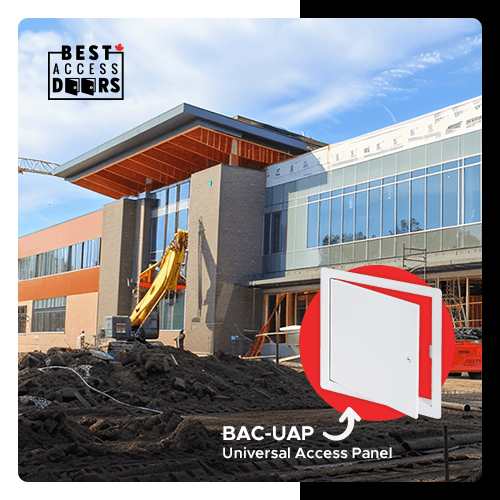
To simplify high-scale construction specifications, you need to standardise a universal, non-rated access panel wherever code and performance allow.
When one universal panel, like the BAC-UAP Universal Access Panel, becomes your default detail for most non-rated walls and ceilings, you can replace long, fragmented schedules with a simple, repeatable spec that’s easy for everyone to follow.
In this article, we’ll look at why access panel specifications become complex on high-scale projects, how universal access panels simplify your workflow, when to lock in selections, and how BAC-UAP supports standardized access panel specs across multiple buildings and phases.
Why Do Access Panel Specifications Become Complex on High-Scale Projects?
Access panel specifications usually become complex on large or multi-phase projects when different trade partners introduce their own preferences and alternates. This quickly creates a mix of panel sizes, materials, and hardware that’s hard to track and coordinate.
Without a single “default” universal access panel in the master specification for non-rated walls and ceilings, each consultant or trade partner tends to solve the same problem in a different way. And with each variation, you end up with more lines in the schedule, more unique tags on drawings, and more product data for procurement and site teams to verify.
Such complexity feeds directly into RFIs and change discussions. Industry research on RFIs shows that responding to a single RFI can cost an average of $1,080 once you factor in design time and administration.
On a high-scale project, that means a confusing access panel schedule can quietly add significant cost when you’re dealing with hundreds of RFIs.
What Risks Do Over-Specified Access Panels Create at Scale?
Over-specified access panels create cost, schedule, and coordination risks at scale because every extra detail increases the chance of errors, delays, and inconsistent installations.
In such a scenario, you’re likely to see issues such as:
- Higher RFI volume as trades try to interpret which panel applies where.
- More substitutions and re-approvals when niche models are difficult to source.
- Change orders when field conditions don’t match the specialty panel assumed on paper.
- Procurement teams carry more risk and effort as they manage several suppliers, lead times, and SKUs for similar openings.
By contrast, simplified construction specifications that rely on universal access panels make it easier to control scope changes, protect budgets, and keep projects moving.
We know not all projects fit neatly into a single standard, and there will always be locations where custom access panels or unique performance requirements are the right answer. In those cases, our team can help you select custom access solutions that still align with your overall standardization strategy.
How Do Universal Access Panels Simplify Drawings and Procurement?
Universal access panels simplify drawings and procurement by providing a clear default option for non-rated walls and ceilings.
Instead of coordinating several models for similar openings, you can specify one universal access panel for most:
- Non-rated gypsum drywall partitions
- Non-rated masonry walls
- Non-rated ceilings where a hinged, flush panel is acceptable
This creates specification standardization and repeatable details. Your drawings and schedules can reference one standard panel tag for most non-rated locations, backed by a single product data sheet and submittal.
Such consistency directly supports commercial procurement efficiency and results in:
- Cleaner drawings with fewer special cases.
- RFI reduction because there’s less ambiguity about which panel to use.
- Procurement consistency with fewer SKUs to manage and better leverage on
- Easier training for site teams who learn one installation approach and one finish standard.
When Should Teams Lock in Universal Access Panel Selections on Large Projects?
Ideally, your universal non-rated access panel model should be confirmed during schematic or early design development, once wall and ceiling systems have been broadly defined.
From there, you should carry it through to typical details, coordinated wall types, bid documents, and trade scopes, so everyone is pricing and installing the same standard panel.
This level of consistency is especially valuable for multi-phase construction planning, because each new phase can reuse the same proven access panel details instead of starting from scratch.
If your team is rolling out standardized specs across multiple Canadian projects, you can join our Pro Club to simplify repeat ordering, pricing, and get priority support from our customer service team.
How Does BAC-UAP Support Standardized Specs across Multiple Buildings or Phases?
The BAC-UAP Universal Access Panel supports standardized specs across multiple buildings or phases by providing your team with a single universal, non-rated access panel that works in both walls and ceilings.
Some of its key features that support repeatable details and lifecycle maintenance planning include:
- Simple installation with a 1" exposed flange that works cleanly with drywall and masonry finishes.
- Durable 16-gauge cold-rolled steel construction for robust performance in commercial settings.
- Moisture- and corrosion-resistant design, finished in a high-quality white powder coat primer.
- Aesthetic flush-to-frame appearance that blends into modern interiors.
- Hidden pin hinge (with a continuous piano hinge on doors over 24" in height or width) for added stability.
- Screwdriver-operated cam latch, which is straightforward for maintenance teams to operate.
Where needed, you can specify options such as:
- Alternative locks and latches, including key-operated cylinder cam latches, hex or pinned hex head cam latches, handle-operated cam latches, and mortise preparation for cylinders.
- Stainless steel 304 #4 brushed finish for more demanding environments.
- Neoprene gasketing where you want added draft control.
Ready to make BAC-UAP access panel your standard for non-rated access points? Request a quote to standardize BAC-UAP across your Canadian projects and simplify access panel procurement across your portfolio.
Frequently Asked Questions on Universal Access Panels
1. Do universal access panels work for both walls and ceilings?
Yes. A universal access panel, like BAC-UAP, is designed for use in non-rated walls and ceilings, so you can rely on a single model across many typical openings. For each location, you still need to verify clearances, structural support, and any special requirements, but the panel itself can remain consistent.
2. Can I use a universal access panel in fire-rated assemblies?
No. Universal access panels, such as BAC-UAP, are intended for non-rated assemblies. For fire-rated walls or ceilings, you must specify a tested, fire-rated access panel that matches the rating and assembly type. Keeping a clear separation between your universal non-rated panel and your fire-rated models helps avoid compliance issues and reduces substitution risk.
3. How early should I decide on a universal access panel for a large project?
You should decide on your universal panel during early design, often before typical details are finalized and bid packages are issued. This allows the design team to coordinate access locations around a known opening size and helps procurement plan bulk purchases and lead times from the start of the project, especially in high-scale commercial construction.
To Sum It Up
On high-scale commercial construction projects, you gain control over risk, cost, and coordination by simplifying and standardizing access panel specifications.
Universal access panels, like the BAC-UAP, provide your team with a reliable default for non-rated walls and ceilings, which helps with cleaner drawings, fewer RFIs, smoother procurement, and a more manageable maintenance portfolio.
Contact our team or call +1-888-327-5471 to plan access strategies that reduce complexity and simplify specifications for your construction projects.