





How to Prevent Damage During Service Access in High-Traffic Commercial Spaces Posted by Best Access Doors Canada on 2nd Apr 2026
You can prevent damage during service access in high-traffic commercial spaces by specifying heavy-duty, secure access panels that can withstand impact, resist tampering, and close reliably after every visit.
When you combine durable, high-traffic access panels with thoughtful placement and maintenance planning, you can reduce repeated drywall repairs, loose hardware, and safety concerns while keeping interiors clean and intentional.
In this article, we’ll look at why access panels are vulnerable in busy environments, which features help prevent damage, and how the BAC-DSD access panel performs in real-world commercial settings.
Why Are Access Panels Vulnerable in High-Traffic Commercial Spaces?
Access panels are vulnerable in high-traffic commercial spaces because they’re usually located in busy corridors and service areas with constant foot and equipment traffic.
In such locations, access doors are often exposed to:
- Frequent opening and closing for maintenance: Mechanical rooms, risers, and above-ceiling spaces in healthcare, education, and retail facilities are accessed regularly. If the panel’s hinge, latch, or closer isn’t designed for this duty cycle, the hardware loosens, and the finishes around the frame start to crack.
- Impact from foot and equipment traffic: Housekeeping carts, trolleys, wheelchairs, stretchers, stock carts, and student traffic all pass close to the wall and ceiling assemblies. Panels with light-gauge frames or shallow hinges can flex and deform under repeated contact.
- Tampering and unauthorized access: In public-use spaces, panels that are easy to open with fingers or improvised tools are attractive targets. Once opened, they can leave sharp edges exposed, compromise fire and smoke control strategies in adjacent assemblies, or cause damage to the systems behind them.
- Finish damage and misalignment: When panels rack or sag due to weak hinges or frames, the door no longer sits flush. This leads to chipped paint, cracked gypsum around the flange, and visible gaps that undermine the finished interior's appearance.
Learn how heavy-duty solutions from Best Access Doors can fit into your high-traffic access strategy to help prevent damage in busy commercial spaces.
Also, if you manage frequent service access, repeated repairs, or large multi-site projects, consider joining our Pro Club to get perks like priority quoting, faster coordination, and dedicated support.
What Features Help Prevent Damage During Routine Service Access?
The features that help prevent damage during routine service access are heavy-gauge construction, robust hinges, self-closing and self-latching hardware, secure and convenient latching options, and details that protect surrounding finishes.
With those core features in mind, look for access doors that offer:
- Heavy-gauge steel construction: 16-gauge cold-rolled steel or similar thickness resists dents, warping, and frame deformation when equipment bumps the door or when it’s opened and closed repeatedly.
- Continuous piano hinge: A full-length hinge distributes stress across the entire edge of the door instead of concentrating it at two or three hinge points. This reduces the risk of sagging, misalignment, and cracked finishes at the jamb, especially in long corridors where panels are opened often.
- Self-closing and self-latching operation: Spring-assisted automatic panel closers pull the door shut consistently after use, without relying on busy technicians to remember to close it.
- Secure latching systems and inside release: Tool-key or ring-operated latches deter casual tampering. Inside panel release supports safe egress for technicians who may be working partly inside tight openings.
- Finish-friendly flanges and options: A wide, exposed flange provides structural support and a clean edge for taping, mudding, or sealant, helping protect finishes at the interface between the door and the wall or ceiling.
How Does BAC-DSD Perform in Busy Commercial Environments?
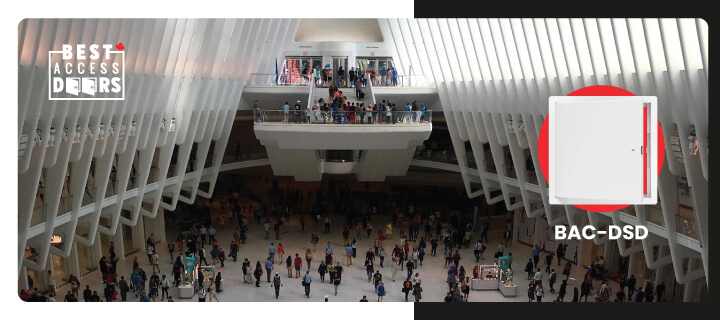
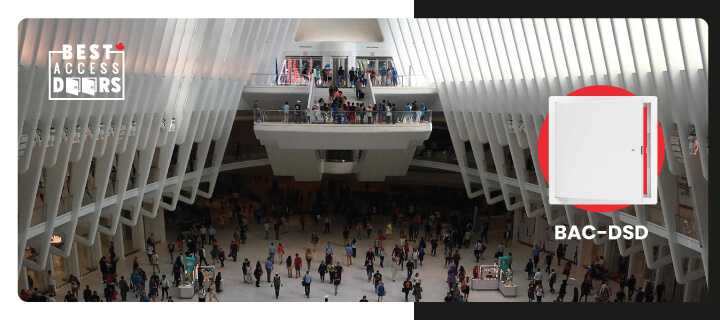
BAC-DSD Draft Stop Access Panel stands out in busy commercial environments because it combines the performance you’d expect from heavy-duty access doors with self-closing and self-latching hardware, flexible locking options, and a draft-stop access design that integrates into non-rated masonry and gypsum drywall structures.
Here’s how it aligns with the performance demands of high-traffic environments.
Heavy-Duty Construction for Impact and Wear
The BAC-DSD access panel is built around a 16-gauge cold-rolled steel door with a flush-to-frame profile and an exposed flange. This combination gives you:
- A solid, impact-resistant face that withstands carts, equipment, and incidental knocks.
- Structural support around the opening, which reduces cracking or spalling of gypsum or masonry around the perimeter.
- A clean, consistent surface for final painting over the high-quality white powder coat primer, which improves chip resistance compared to basic primed steel.
The continuous piano hinge further improves lifecycle durability. In high-traffic settings like hospital corridors or retail back rooms, that hinge design helps the door open smoothly and return to alignment after thousands of opening and closing cycles.
Self-Closing, Self-Latching, and Two-Way Access
BAC-DSD is designed to be safe for maintenance teams to access service areas regularly. As a result, it comes with features like:
- Spring-assisted self-closing and self-latching is standard on all doors, so the panel pulls itself closed after service.
- Two-way access makes it easier for technicians to reach equipment and valve groups from different directions, where the layout allows.
- An inside panel release on every door that supports safe operation for staff working through tight openings.
Tamper-Resistant Design and Secure Access
BAC-DSD comes with a self-latching tool-key latch and a ring-operated latch to prevent unauthorized opening in busy areas.
For higher-risk or more public areas, you can specify optional locking upgrades such as:
- Key-operated cylinder cam latch
- Mortise deadbolt lock
- Handle-operated slam latch
- Mortise preparation for a cylinder (cylinder optional)
Material and Gasketing Options for Specialized Spaces
In areas where you expect moisture, frequent cleaning, or harsh environmental conditions, you can order BAC-DSD in:
- Stainless steel 304 with a #4 brushed finish for improved corrosion resistance and easier cleaning.
- Neoprene gasketing that provides a more cushioned close, reduces rattling, and supports draft control around the perimeter of the panel.
If you’re looking for damage-resistant access panels that can withstand impact, tampering, and frequent use, request a quote for BAC-DSD to reduce service-related damage and maintenance costs.
FAQs on Damage-Resistant Access Panels in Canada
1. When should damage-resistant access panels be specified to reduce lifecycle costs?
You should specify damage-resistant access panels early in design for any area you expect frequent access, heavy traffic, or public exposure, because the cost of repeated repairs can quickly outweigh the premium on a durable panel.
Key locations to specify this type of access panel include:
- Main and service corridors in healthcare, education, and transit facilities.
- Retail back-of-house areas and stockrooms.
- Mechanical and electrical rooms that are accessed multiple times per year.
- Public washrooms and service spaces are exposed to tampering.
2. Can commercial maintenance access solutions be retrofitted into existing walls and ceilings?
In many cases, yes. High-traffic access panels can be retrofitted into existing non-rated gypsum or masonry walls and ceilings, provided the opening is properly framed and sized in accordance with the manufacturer’s requirements.
Retrofits are often a cost-effective way to replace repeatedly damaged light-duty panels with more durable commercial access doors, especially in older facilities where maintenance teams are already dealing with a backlog of repairs.
If you’re unsure whether a location is suitable for retrofit, a quick review with your supplier or specifier can help confirm clearances, framing, and lock options.
3. How does secure, heavy-duty construction reduce tampering and impact risk?
Secure, heavy-duty construction reduces tampering and impact risk by making panels harder to pry open casually and more resistant to dents and misalignment when they’re bumped or used frequently.
On the ground, this translates into:
- Impact resistance: 16-gauge steel and a robust frame are less likely to deform under everyday knocks, so the door continues to close and latch correctly.
- Tamper-resistant design: Tool-key, ring-operated, or keyed cylinder latches discourage opportunistic opening by occupants or visitors, reducing risk of injuries and interference with mechanical and electrical systems.
- Lifecycle durability: A continuous piano hinge and self-closing mechanism help the door keep its alignment, so gaps don’t appear to encourage further tampering or make the door easier to force open.
To Sum It Up
Preventing damage during service access in high-traffic commercial spaces comes down to specifying the right access door from the start and coordinating it as you would any other critical building component.
By focusing on features like heavy-gauge steel construction, continuous hinges, and self-closing and self-latching hardware, you can specify high-traffic access panels that can withstand repeated use.
If you’re planning a new build or upgrading existing interiors, contact our team or call +1-888-327-5471 to coordinate damage-resistant access panels for your next commercial project.